skincare
Anti-Aging Skincare Tips for Women Over 40
Five ingredients that move the needle on skin aging after 40 — retinol, hyaluronic acid, daily SPF, eye area care, and why sleep beats any serum.
Read more →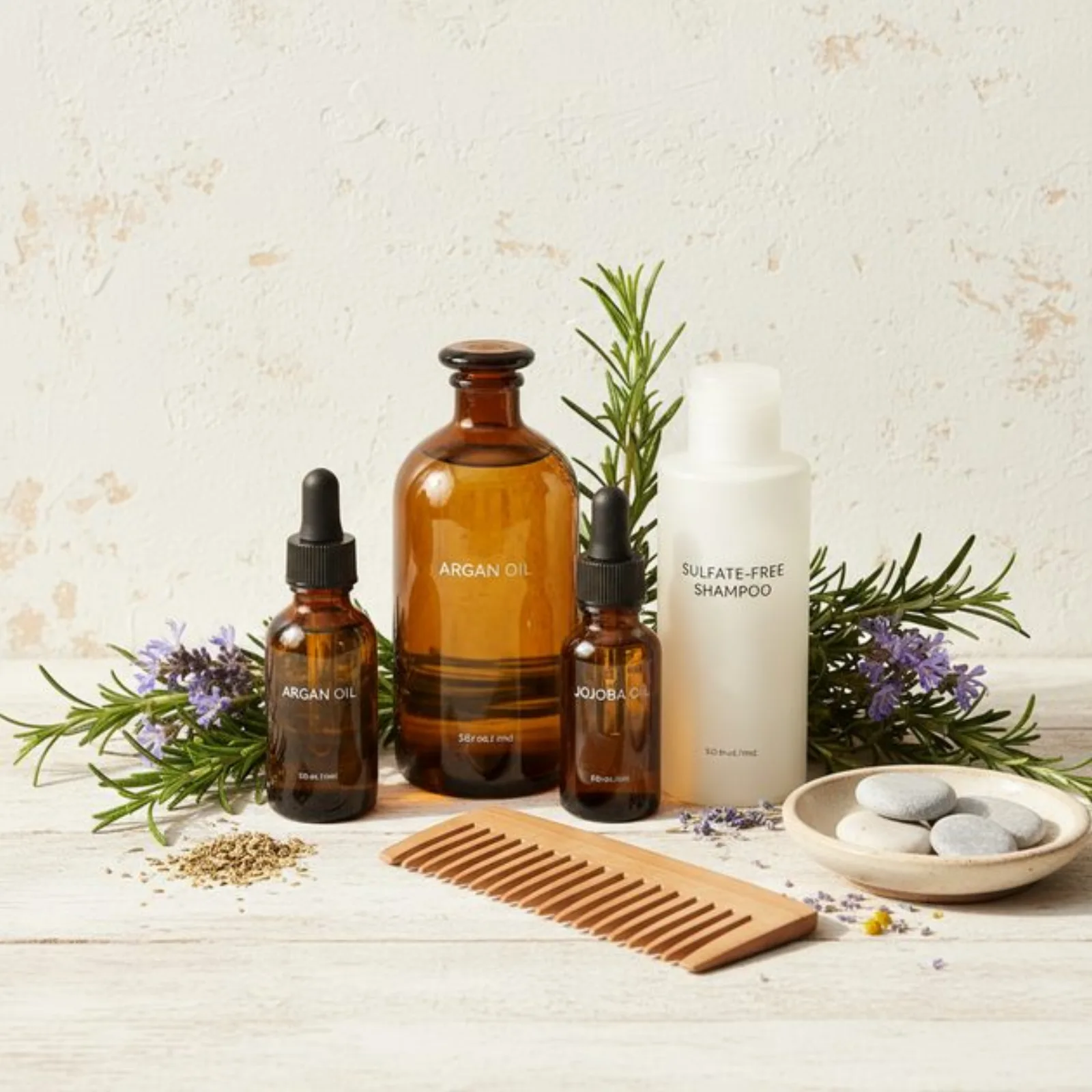
📋 Quick Summary
Walking down the hair care aisle has become an exercise in label-reading anxiety. Everything claims to be “natural,” “clean,” or “botanical” — but most of those terms aren’t regulated, which means a product can carry that label while still being full of sulfates, silicones, and synthetic fragrance.
This guide cuts through the noise. It covers what the science actually says about key natural hair care ingredients, which products genuinely deliver, and how to build a simple routine that works — without spending a small fortune or storing fifteen bottles on your shower shelf.
This article pairs well with our natural anti-aging skincare routine — because what you put on your scalp affects skin health just as much as what you apply to your face.
The scalp is skin. It absorbs what you put on it, and what disrupts the scalp barrier tends to show up as inflammation, flaking, excess oil production, or slow hair growth. Most conventional shampoos use sodium lauryl sulfate (SLS) or sodium laureth sulfate (SLES) as their primary cleansers. These surfactants are effective at removing oil — almost too effective. For women with dry, color-treated, or chemically processed hair, they strip away more natural sebum than the scalp can comfortably replace.
A 2015 review published in the International Journal of Trichology found that cosmetic ingredient sensitivity — particularly to preservatives and fragrances — accounts for a significant portion of scalp dermatitis cases. Switching to simpler, fragrance-free formulas resolves the issue for many women without any other intervention.
Beyond irritation, there’s the cumulative buildup question. Silicones — ingredients ending in “-cone,” “-xane,” or “-conol” — create a smooth feel and reduce frizz in the short term. Over weeks of use, they coat the hair shaft and eventually prevent moisture from penetrating. Hair starts to feel heavy, dull, and product-dependent. Natural hair care approaches tend to avoid silicones entirely, which can cause a brief adjustment period when you switch, but pays off in genuinely healthier hair structure over time.
Not all sulfate-free shampoos are equal. Some replace SLS with equally harsh alternatives. The formulas worth using rely on gentler surfactants like cocamidopropyl betaine (derived from coconut oil), sodium cocoyl isethionate, or decyl glucoside — all of which clean effectively without stripping.
SheaMoisture Curl and Shine Shampoo (briogeo.com) is phthalate-free, paraben-free, and cruelty-free. It uses coconut oil, silk protein, and neem oil to cleanse while maintaining moisture for curly and wavy hair types. The brand is consistent and widely available at mass retailers.
Briogeo holds itself to a 6-free standard: no sulfates, silicones, phthalates, parabens, DEA, or artificial dyes. Their Scalp Revival Charcoal + Coconut Oil Micro-Exfoliating Shampoo ($42 for 16 oz) is particularly effective for women dealing with product buildup or a flaky scalp. The charcoal gently draws out impurities while coconut oil prevents the scalp from feeling stripped.
Plaine Products uses aloe leaf juice, vitamin E, and sea kelp in refillable aluminum bottles — an EWG Verified score of 1 (their highest rating) and fully fragrance-free options for sensitive scalps. Priced at around $47 per bottle, it’s an investment, but the refill model reduces the per-ounce cost significantly over time.
For a budget-friendly entry point, L’Oréal EverPure Sulfate-Free Moisture Shampoo (around $9 at drugstores) performs well for color-treated hair and is widely available. It’s not certified clean, but it avoids sulfates and works reliably for women transitioning away from conventional formulas.
Hair oils have been used for centuries across many cultures, and most of them have genuine functional purposes beyond making hair look shiny. The key is matching the oil to your specific hair need.
Argan oil comes from the kernels of the Argania spinosa tree in Morocco and is rich in oleic acid, vitamin E, and polyphenols. A 2015 study published in ISRN Dermatology found that argan oil improves hair fiber surface texture and reduces frizz by coating the cuticle without penetrating the shaft deeply — making it ideal as a finishing oil applied to dry hair.
It’s particularly effective for women with coarse, dry, or chemically processed hair. Use 2–3 drops on the mid-lengths and ends after washing. Avoid the scalp — oils applied to the scalp can clog follicles in some cases, especially if you’re prone to seborrheic dermatitis.
Jojoba is technically a liquid wax, not an oil — which is why it behaves differently from other plant oils. Its molecular structure closely resembles human sebum, making it uniquely compatible with the scalp. A 2019 review in Molecules confirmed jojoba’s antibacterial and anti-inflammatory properties, which supports its traditional use for scalp conditions including flaking and mild inflammation.
Jojoba is light enough to use on fine hair without weighing it down. It’s also one of the most shelf-stable natural oils — it won’t go rancid the way rosehip or hemp seed oil can.
Research on jojoba oil and hair growth points to scalp health as the primary mechanism. Because jojoba’s molecular structure closely resembles human sebum, it helps regulate the scalp’s natural oil balance — an environment that supports healthy follicle function. Its documented anti-inflammatory and antibacterial properties (confirmed in a 2019 review published in Molecules, PMC) help reduce the scalp irritation and low-grade inflammation that can impair hair growth over time. While large-scale clinical trials specifically measuring jojoba’s effect on hair growth rate are limited, the available evidence supports its use as a scalp-conditioning ingredient that addresses key factors — barrier disruption, inflammation, and sebum dysregulation — associated with suboptimal hair growth.
Coconut oil has dominated the natural hair care conversation for years, and it does have genuine evidence behind it. A 2003 study in the Journal of Cosmetic Science found that coconut oil significantly reduces protein loss in both damaged and undamaged hair — more effectively than mineral oil or sunflower oil — because its lauric acid can actually penetrate the hair shaft.
The caveat: coconut oil works best as a pre-wash treatment, left on dry hair for 30–60 minutes before shampooing. Used daily or left on overnight repeatedly, it can cause buildup. And as noted in our guide to natural face oils, coconut oil is highly comedogenic — keep it off your forehead and hairline.
Less discussed than argan or coconut, rosehip oil has a strong case for scalp health specifically. It’s high in linoleic acid and vitamin A precursors that support skin cell turnover — relevant for a scalp that’s dealing with flaking, inflammation, or slow circulation. Our rosehip oil guide covers its skincare benefits in detail, but many of those same properties translate to scalp application in a diluted form.
Conditioner is where many natural formulas still struggle. Getting slip and detangling ability without silicones requires more sophisticated formulation — which is why some “natural” conditioners feel watery or thin.
Sienna Naturals (available at Target and online, around $18–22) uses aloe leaf juice, baobab oil, and coconut oil in a phenoxyethanol-free, silicone-free formula. It’s designed for textured and curly hair but works well on fine wavy hair too. EWG verified at a score of 2.
Carina Organics Daily Moisturizing Conditioner is one of the more genuinely clean options at a reasonable price (around $16). It contains a short ingredient list, is available unscented, and is certified vegan and cruelty-free. For women with fragrance sensitivities, this is worth prioritizing.
For deep conditioning, a simple DIY hair mask works as well as most purchased options: mix 1 tablespoon of jojoba oil with 2 tablespoons of plain Greek yogurt (lactic acid gently exfoliates the scalp) and a teaspoon of raw honey (a natural humectant). Apply to damp hair, leave for 20–30 minutes, rinse thoroughly. This approach pairs naturally with the DIY ethos covered in our vitamin C serum guide — sometimes the most effective ingredients are the most straightforward ones.
A healthy scalp grows healthy hair. Period. Most women focus on the hair itself and ignore the scalp — which is the opposite of where results actually come from.
For a flaky scalp that isn’t dandruff (seborrheic dermatitis), the issue is often a disrupted skin barrier from over-washing with harsh surfactants. Switching to a gentler shampoo, adding a weekly jojoba oil scalp massage, and reducing wash frequency from daily to every other day resolves it in many cases within 4–6 weeks.
For genuine seborrheic dermatitis (characterized by greasy yellow-white flakes, redness, and persistent itching), a clinically validated active ingredient is needed. Pyrithione zinc (ZPT) at 1–2% concentration and ketoconazole are the most evidence-backed treatments. Natural alternatives like tea tree oil have some supporting data — a 5% tea tree oil shampoo showed meaningful improvement in a randomized controlled trial — but they’re less reliable for moderate to severe cases.
Rosemary oil has received significant attention after a 2023 study in Skinmed showed it performed comparably to 2% minoxidil for hair growth after 6 months. The mechanism is increased scalp microcirculation. Dilute it to a 2–3% concentration in jojoba oil (about 10–15 drops of rosemary essential oil per ounce of carrier) and massage into the scalp 3–4 times per week.
The most effective natural hair care routine is the one that’s consistent, not the one with the most steps or the most expensive bottles.
Wash frequency: Most women wash too often. Unless you have a very oily scalp or exercise daily, every 2–3 days is sufficient for most hair types. Over-washing is one of the primary drivers of dry, brittle hair.
Wash day routine:
Between washes:
Monthly deep treatment: One of the hair masks above, or a 20-minute hot oil treatment (warm jojoba in your palms, work through mid-lengths and ends, cover with a shower cap).
What you’re looking for in a natural hair care routine isn’t magic. It’s removing the ingredients that are causing damage, giving your scalp and hair fiber what they actually need to function, and being consistent enough to see the results — which typically emerge over 6–8 weeks of regular use.
For more natural beauty and skincare guides, browse our full Natural Beauty & Skincare collection.
→ Explore more in our Skincare Hub.
skincare
Five ingredients that move the needle on skin aging after 40 — retinol, hyaluronic acid, daily SPF, eye area care, and why sleep beats any serum.
Read more →
skincare
Which face oils genuinely help mature skin — and which are just expensive bottles of empty hype. An honest, clear breakdown.
Read more →
skincare
Best natural moisturizers for dry skin — from shea butter to squalane. Evidence-based ingredients, a DIY recipe, and what dermatologists recommend.
Read more →
Get access to my VIP newsletter with health tips, special deals, my free ebook on Seven Small Easy Habits and so much more!